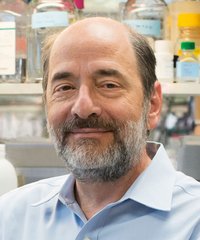
Portrait of a smiling man with short brown-and-gray hair and a salt-and-pepper beard, wearing a light blue collared shirt in a laboratory or pharmacy setting.

Michael Greenberg, Ph.D.

Nathan Marsh Pusey Professor of Neurobiology, Harvard Medical School
Professor of Neurology, Boston Children's Hospital
Director of the Hock E. Tan and K. Lisa Yang Center for Autism Research, Harvard Medical School

Michael Greenberg, Ph.D. – Faculty Profile

If you prefer, you can view the visual layout directly on Canva: Open Michael Greenberg – Faculty Profile on Canva (opens in a new window) .

Title: Nathan Marsh Pusey Professor of Neurobiology, Harvard Medical School; Director of the Hock E. Tan and K. Lisa Yang Center for Autism Research, Harvard Medical School; Professor of Neurology, Boston Children's Hospital.

The Aim

The Greenberg Lab studies how life experiences turn genes on or off to shape learning and brain development. The lab focuses on the molecular mechanisms by which sensory experiences regulate gene expression in the brain.

The Impact

This research has illuminated how the brain rewires itself in response to experience, a process essential for learning, memory, and behavior. Several of the genes and pathways the lab has identified are mutated in autism and other neurodevelopmental disorders, positioning this work as foundational for developing new therapies for these conditions.

A Closer Look

Article: State of Stasis , Harvard Medical School / Harvard Gazette, June 2020. This piece describes how Mike Greenberg and colleagues identified a tiny cluster of hypothalamic neurons that can flip mice into and out of a hibernation‑like state, or torpor, revealing brain circuits that dial down body temperature and metabolism and opening avenues for understanding suspended animation and its medical uses.

Article: Research Reveals Link Between Stress Hormone, Brain Plasticity in Early Life , Harvard Medical School, May 2026. This article describes a Nature study led by Mike Greenberg showing that in mice, the stress hormone cortisol sets off a chain of changes in star‑shaped brain cells called astrocytes. These changes help close critical periods of learning early in life by turning on more than 100 genes that mature the matrix surrounding neurons, and an analysis of human brain data suggests the same pathway exists in people.

Contact

Email: michael_greenberg@hms.harvard.edu
Lab website: greenberg.hms.harvard.edu

Publications View
Analysis of phosphorylation-dependent protein-protein interactions using a bacterial two-hybrid system.
Authors: Authors: Shaywitz AJ, Dove SL, Greenberg ME, Hochschild A.
Sci STKE
View full abstract on Pubmed
The IGF-1/Akt pathway is neuroprotective in Huntington's disease and involves Huntingtin phosphorylation by Akt.
Authors: Authors: Humbert S, Bryson EA, Cordelières FP, Connors NC, Datta SR, Finkbeiner S, Greenberg ME, Saudou F.
Dev Cell
View full abstract on Pubmed
DNA repair pathway stimulated by the forkhead transcription factor FOXO3a through the Gadd45 protein.
Authors: Authors: Tran H, Brunet A, Grenier JM, Datta SR, Fornace AJ, DiStefano PS, Chiang LW, Greenberg ME.
Science
View full abstract on Pubmed
CREB transcriptional activity in neurons is regulated by multiple, calcium-specific phosphorylation events.
Authors: Authors: Kornhauser JM, Cowan CW, Shaywitz AJ, Dolmetsch RE, Griffith EC, Hu LS, Haddad C, Xia Z, Greenberg ME.
Neuron
View full abstract on Pubmed
14-3-3 transits to the nucleus and participates in dynamic nucleocytoplasmic transport.
Authors: Authors: Brunet A, Kanai F, Stehn J, Xu J, Sarbassova D, Frangioni JV, Dalal SN, DeCaprio JA, Greenberg ME, Yaffe MB.
J Cell Biol
View full abstract on Pubmed
A calcium-responsive transcription factor, CaRF, that regulates neuronal activity-dependent expression of BDNF.
Authors: Authors: Tao X, West AE, Chen WG, Corfas G, Greenberg ME.
Neuron
View full abstract on Pubmed
Modulation of NMDA receptor-dependent calcium influx and gene expression through EphB receptors.
Authors: Authors: Takasu MA, Dalva MB, Zigmond RE, Greenberg ME.
Science
View full abstract on Pubmed
14-3-3 inhibits Bad-induced cell death through interaction with serine-136.
Authors: Authors: Masters SC, Yang H, Datta SR, Greenberg ME, Fu H.
Mol Pharmacol
View full abstract on Pubmed
Mutation of E2F2 in mice causes enhanced T lymphocyte proliferation, leading to the development of autoimmunity.
Authors: Authors: Murga M, Fernández-Capetillo O, Field SJ, Moreno B, Borlado LR, Fujiwara Y, Balomenos D, Vicario A, Carrera AC, Orkin SH, Greenberg ME, Zubiaga AM.
Immunity
View full abstract on Pubmed
The E2F1-3 transcription factors are essential for cellular proliferation.
Authors: Authors: Wu L, Timmers C, Maiti B, Saavedra HI, Sang L, Chong GT, Nuckolls F, Giangrande P, Wright FA, Field SJ, Greenberg ME, Orkin S, Nevins JR, Robinson ML, Leone G.
Nature
View full abstract on Pubmed