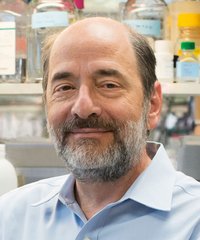
Portrait of a smiling man with short brown-and-gray hair and a salt-and-pepper beard, wearing a light blue collared shirt in a laboratory or pharmacy setting.

Michael Greenberg, Ph.D.

Nathan Marsh Pusey Professor of Neurobiology, Harvard Medical School
Professor of Neurology, Boston Children's Hospital
Director of the Hock E. Tan and K. Lisa Yang Center for Autism Research, Harvard Medical School

Michael Greenberg, Ph.D. – Faculty Profile

If you prefer, you can view the visual layout directly on Canva: Open Michael Greenberg – Faculty Profile on Canva (opens in a new window) .

Title: Nathan Marsh Pusey Professor of Neurobiology, Harvard Medical School; Director of the Hock E. Tan and K. Lisa Yang Center for Autism Research, Harvard Medical School; Professor of Neurology, Boston Children's Hospital.

The Aim

The Greenberg Lab studies how life experiences turn genes on or off to shape learning and brain development. The lab focuses on the molecular mechanisms by which sensory experiences regulate gene expression in the brain.

The Impact

This research has illuminated how the brain rewires itself in response to experience, a process essential for learning, memory, and behavior. Several of the genes and pathways the lab has identified are mutated in autism and other neurodevelopmental disorders, positioning this work as foundational for developing new therapies for these conditions.

A Closer Look

Article: State of Stasis , Harvard Medical School / Harvard Gazette, June 2020. This piece describes how Mike Greenberg and colleagues identified a tiny cluster of hypothalamic neurons that can flip mice into and out of a hibernation‑like state, or torpor, revealing brain circuits that dial down body temperature and metabolism and opening avenues for understanding suspended animation and its medical uses.

Article: Research Reveals Link Between Stress Hormone, Brain Plasticity in Early Life , Harvard Medical School, May 2026. This article describes a Nature study led by Mike Greenberg showing that in mice, the stress hormone cortisol sets off a chain of changes in star‑shaped brain cells called astrocytes. These changes help close critical periods of learning early in life by turning on more than 100 genes that mature the matrix surrounding neurons, and an analysis of human brain data suggests the same pathway exists in people.

Contact

Email: michael_greenberg@hms.harvard.edu
Lab website: greenberg.hms.harvard.edu

Publications View
MEF2D drives photoreceptor development through a genome-wide competition for tissue-specific enhancers.
Authors: Authors: Andzelm MM, Cherry TJ, Harmin DA, Boeke AC, Lee C, Hemberg M, Pawlyk B, Malik AN, Flavell SW, Sandberg MA, Raviola E, Greenberg ME.
Neuron
View full abstract on Pubmed
The Eya1 phosphatase promotes Shh signaling during hindbrain development and oncogenesis.
Authors: Authors: Eisner A, Pazyra-Murphy MF, Durresi E, Zhou P, Zhao X, Chadwick EC, Xu PX, Hillman RT, Scott MP, Greenberg ME, Segal RA.
Dev Cell
View full abstract on Pubmed
Genome-wide identification and characterization of functional neuronal activity-dependent enhancers.
Authors: Authors: Malik AN, Vierbuchen T, Hemberg M, Rubin AA, Ling E, Couch CH, Stroud H, Spiegel I, Farh KK, Harmin DA, Greenberg ME.
Nat Neurosci
View full abstract on Pubmed
Npas4 regulates excitatory-inhibitory balance within neural circuits through cell-type-specific gene programs.
Authors: Authors: Spiegel I, Mardinly AR, Gabel HW, Bazinet JE, Couch CH, Tzeng CP, Harmin DA, Greenberg ME.
Cell
View full abstract on Pubmed
MeCP2 phosphorylation limits psychostimulant-induced behavioral and neuronal plasticity.
Authors: Authors: Deng JV, Wan Y, Wang X, Cohen S, Wetsel WC, Greenberg ME, Kenny PJ, Calakos N, West AE.
J Neurosci
View full abstract on Pubmed
EphB receptor forward signaling regulates area-specific reciprocal thalamic and cortical axon pathfinding.
Authors: Authors: Robichaux MA, Chenaux G, Ho HY, Soskis MJ, Dravis C, Kwan KY, Šestan N, Greenberg ME, Henkemeyer M, Cowan CW.
Proc Natl Acad Sci U S A
View full abstract on Pubmed
The activity-dependent transcription factor NPAS4 regulates domain-specific inhibition.
Authors: Authors: Bloodgood BL, Sharma N, Browne HA, Trepman AZ, Greenberg ME.
Nature
View full abstract on Pubmed
Exercise induces hippocampal BDNF through a PGC-1a/FNDC5 pathway.
Authors: Authors: Wrann CD, White JP, Salogiannnis J, Laznik-Bogoslavski D, Wu J, Ma D, Lin JD, Greenberg ME, Spiegelman BM.
Cell Metab
View full abstract on Pubmed
Genetics. The maturing brain methylome.
Authors: Authors: Gabel HW, Greenberg ME.
Science
View full abstract on Pubmed
Activity-dependent phosphorylation of MeCP2 threonine 308 regulates interaction with NCoR.
Authors: Authors: Ebert DH, Gabel HW, Robinson ND, Kastan NR, Hu LS, Cohen S, Navarro AJ, Lyst MJ, Ekiert R, Bird AP, Greenberg ME.
Nature
View full abstract on Pubmed