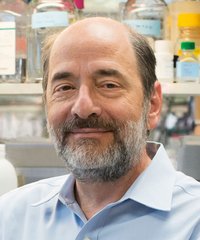
Portrait of a smiling man with short brown-and-gray hair and a salt-and-pepper beard, wearing a light blue collared shirt in a laboratory or pharmacy setting.

Michael Greenberg, Ph.D.

Nathan Marsh Pusey Professor of Neurobiology, Harvard Medical School
Professor of Neurology, Boston Children's Hospital
Director of the Hock E. Tan and K. Lisa Yang Center for Autism Research, Harvard Medical School

Michael Greenberg, Ph.D. – Faculty Profile

If you prefer, you can view the visual layout directly on Canva: Open Michael Greenberg – Faculty Profile on Canva (opens in a new window) .

Title: Nathan Marsh Pusey Professor of Neurobiology, Harvard Medical School; Director of the Hock E. Tan and K. Lisa Yang Center for Autism Research, Harvard Medical School; Professor of Neurology, Boston Children's Hospital.

The Aim

The Greenberg Lab studies how life experiences turn genes on or off to shape learning and brain development. The lab focuses on the molecular mechanisms by which sensory experiences regulate gene expression in the brain.

The Impact

This research has illuminated how the brain rewires itself in response to experience, a process essential for learning, memory, and behavior. Several of the genes and pathways the lab has identified are mutated in autism and other neurodevelopmental disorders, positioning this work as foundational for developing new therapies for these conditions.

A Closer Look

Article: State of Stasis , Harvard Medical School / Harvard Gazette, June 2020. This piece describes how Mike Greenberg and colleagues identified a tiny cluster of hypothalamic neurons that can flip mice into and out of a hibernation‑like state, or torpor, revealing brain circuits that dial down body temperature and metabolism and opening avenues for understanding suspended animation and its medical uses.

Article: Research Reveals Link Between Stress Hormone, Brain Plasticity in Early Life , Harvard Medical School, May 2026. This article describes a Nature study led by Mike Greenberg showing that in mice, the stress hormone cortisol sets off a chain of changes in star‑shaped brain cells called astrocytes. These changes help close critical periods of learning early in life by turning on more than 100 genes that mature the matrix surrounding neurons, and an analysis of human brain data suggests the same pathway exists in people.

Contact

Email: michael_greenberg@hms.harvard.edu
Lab website: greenberg.hms.harvard.edu

Publications View
Rett syndrome mutations abolish the interaction of MeCP2 with the NCoR/SMRT co-repressor.
Authors: Authors: Lyst MJ, Ekiert R, Ebert DH, Merusi C, Nowak J, Selfridge J, Guy J, Kastan NR, Robinson ND, de Lima Alves F, Rappsilber J, Greenberg ME, Bird A.
Nat Neurosci
View full abstract on Pubmed
Exome sequencing reveals new causal mutations in children with epileptic encephalopathies.
Authors: Authors: Veeramah KR, Johnstone L, Karafet TM, Wolf D, Sprissler R, Salogiannis J, Barth-Maron A, Greenberg ME, Stuhlmann T, Weinert S, Jentsch TJ, Pazzi M, Restifo LL, Talwar D, Erickson RP, Hammer MF.
Epilepsia
View full abstract on Pubmed
Neuronal Per Arnt Sim (PAS) domain protein 4 (NPAS4) regulates neurite outgrowth and phosphorylation of synapsin I.
Authors: Authors: Yun J, Nagai T, Furukawa-Hibi Y, Kuroda K, Kaibuchi K, Greenberg ME, Yamada K.
J Biol Chem
View full abstract on Pubmed
Using whole-exome sequencing to identify inherited causes of autism.
Authors: Authors: Yu TW, Chahrour MH, Coulter ME, Jiralerspong S, Okamura-Ikeda K, Ataman B, Schmitz-Abe K, Harmin DA, Adli M, Malik AN, D'Gama AM, Lim ET, Sanders SJ, Mochida GH, Partlow JN, Sunu CM, Felie JM, Rodriguez J, Nasir RH, Ware J, Joseph RM, Hill RS, Kwan BY, Al-Saffar M, Mukaddes NM, Hashmi A, Balkhy S, Gascon GG, Hisama FM, LeClair E, Poduri A, Oner O, Al-Saad S, Al-Awadi SA, Bastaki L, Ben-Omran T, Teebi AS, Al-Gazali L, Eapen V, Stevens CR, Rappaport L, Gabriel SB, Markianos K, State MW, Greenberg ME, Taniguchi H, Braverman NE, Morrow EM, Walsh CA.
Neuron
View full abstract on Pubmed
Activity-dependent neuronal signalling and autism spectrum disorder.
Authors: Authors: Ebert DH, Greenberg ME.
Nature
View full abstract on Pubmed
Seroepidemiologic effects of influenza A(H1N1)pdm09 in Australia, New Zealand, and Singapore.
Authors: Authors: Trauer JM, Bandaranayake D, Booy R, Chen MI, Cretikos M, Dowse GK, Dwyer DE, Greenberg ME, Huang QS, Khandaker G, Kok J, Laurie KL, Lee VJ, McVernon J, Walter S, Markey PG.
Emerg Infect Dis
View full abstract on Pubmed
A chemical genetic approach reveals distinct EphB signaling mechanisms during brain development.
Authors: Authors: Soskis MJ, Ho HY, Bloodgood BL, Robichaux MA, Malik AN, Ataman B, Rubin AA, Zieg J, Zhang C, Shokat KM, Sharma N, Cowan CW, Greenberg ME.
Nat Neurosci
View full abstract on Pubmed
Integrated genome analysis suggests that most conserved non-coding sequences are regulatory factor binding sites.
Authors: Authors: Hemberg M, Gray JM, Cloonan N, Kuersten S, Grimmond S, Greenberg ME, Kreiman G.
Nucleic Acids Res
View full abstract on Pubmed
Microglia sculpt postnatal neural circuits in an activity and complement-dependent manner.
Authors: Authors: Schafer DP, Lehrman EK, Kautzman AG, Koyama R, Mardinly AR, Yamasaki R, Ransohoff RM, Greenberg ME, Barres BA, Stevens B.
Neuron
View full abstract on Pubmed
Wnt5a-Ror-Dishevelled signaling constitutes a core developmental pathway that controls tissue morphogenesis.
Authors: Authors: Ho HY, Susman MW, Bikoff JB, Ryu YK, Jonas AM, Hu L, Kuruvilla R, Greenberg ME.
Proc Natl Acad Sci U S A
View full abstract on Pubmed