
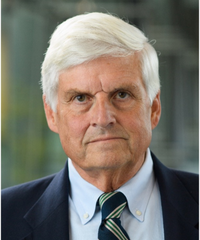
David Corey, Ph.D.
Open the David Corey faculty profile graphic in Canva (opens in a new tab)
David Corey, PhD
Bertarelli Professor of Translational Medical Science
Department of Neurobiology, Harvard Medical School
Email:
david_corey@hms.harvard.edu
Website:
Corey Lab website – more information about David Corey’s research (opens in a new tab)
The Aim
The Corey Laboratory studies how the inner ear turns sound into neural signals, and is translating their findings into gene therapy for hereditary hearing loss.
The Impact
At the heart of our ability to hear is a remarkable mechanical feat: when sound waves reach the inner ear, tiny hair‑like structures bend, opening microscopic channels that produce electrical signals the brain interprets as sound. Our laboratory has spent decades uncovering the molecular basis of this process. Mutations in the genes encoding these proteins can cause hereditary deafness, as in Usher syndrome, in which hearing loss is accompanied by blindness. Building on this molecular understanding, we are now developing gene therapy strategies with the potential to restore hearing and vision in people affected by these disorders.
A Closer Look
Harvard Medical School News – March 2026: Evolution of TMC1 and future therapies for hearing loss (article, opens in a new tab)
The Corey Lab has traced the evolution of TMC1, the protein that lets vertebrates hear. This reveals a tiny loop critical to the protein’s function and to the design of future therapies for hearing loss.
Harvard Medical School News – November 2024: Gene therapy strategy for Usher syndrome (article, opens in a new tab)
This HMS News feature highlights the Corey lab’s report of a second strategy for delivering a corrected gene to patients with Usher syndrome, a rare condition causing both deafness and blindness. The therapy restored hearing in mice and showed early signs of improving vision in primates.
Image descriptions
Inner ear hair‑cell bundles image: Tiny hair‑cell bundles in the inner ear, shown in a colorized scanning electron microscope image, are essential for hearing and balance. In the cochlea, the protein TMC1 sits atop each cilium of a bundle. Image credit: John Assad and David Corey.
Retina gene therapy image: An experimental gene therapy raised levels of the key protein protocadherin‑15, shown in green, in light‑sensing cells in the retinas of nonhuman primates. Image credit: Maryna Ivanchenko.
Visit here to see Dr. Corey's publications.