
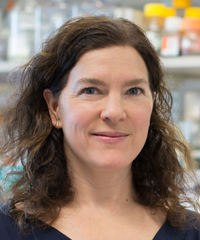
Lisa Goodrich, Ph.D.
Lisa Goodrich, PhD – People Feature
Professor of Neurobiology and Department Vice Chair in the Department of Neurobiology at Harvard Medical School.
If you prefer, you can view the visual layout directly on Canva by Neuro Coordinator.
Contact
Email: lisa_goodrich@hms.harvard.edu
Goodrich Lab website: goodrich.med.harvard.edu
The Goal
The Goodrich Lab studies how hearing circuits form and function, and what leads to their deterioration.
The Impact
Studying how the brain and ear work together to produce our sense of hearing offers insight into a key sensory system that people and animals use to navigate the world.
Hearing can be impaired by genetic mutations, infection, or exposure to excessively loud sounds. Deciphering the cellular and molecular mechanisms underlying the formation and function of auditory circuits may lead to improved protection of hearing and treatments for hearing loss.
This work has the potential to help people of all ages more fully enjoy the sounds that enrich our lives.
A Closer Look
Harvard Medicine Magazine — Spring 2020: 5 Questions with a Neurobiologist: A Conversation with Lisa Goodrich
Lisa reflects on the rewards and challenges of life as a researcher and offers advice for others interested in pursuing scientific research. She discusses the molecular origins of sensory circuits, the rewards of scientific discovery, and the importance of flexibility in research and career paths.
Harvard Medical School News — November 2011: Bioengineering for Hearing, Sight and Mobility
Dr. Goodrich presented her research at the inaugural Bertarelli Neuroengineering Symposium in Lausanne, Switzerland. Support from the Bertarelli Foundation funded a project in her lab with the potential to help people whose lives are affected by hearing loss.
The featured research focuses on understanding auditory hair cells and developing approaches that could support improved treatments for hearing loss.
J Comp Neurol
View full abstract on Pubmed
PLoS One
View full abstract on Pubmed
Development
View full abstract on Pubmed
Development
View full abstract on Pubmed
J Neurosci
View full abstract on Pubmed
J Neurosci
View full abstract on Pubmed