
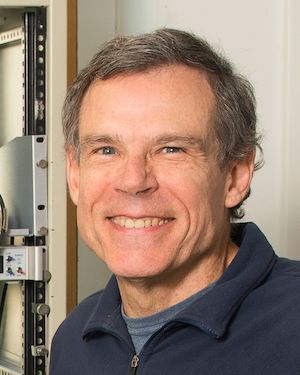
Bruce Bean

Bruce Palmer Bean, PhD

Robert Winthrop Professor of Neurobiology

Neuronal Excitability and Ion Channel Pharmacology

Neurons communicate with each other using electrical impulses. Information is encoded as patterns of “action potentials”, millisecond-long reversals of the voltage across the cell membrane. Different neurons in the brain fire action potentials with a variety of distinct patterns. The Bean lab seeks to understand these different patterns of firing in terms of the underlying molecular devices – tiny pores in the membrane known as ion channels.

In mammalian brains, each neuron possesses several dozen different types of ion channels. Most of these are closed when the neuron is at rest (electrically silent). It is the coordinated, transient opening, or “gating” of particular types of ion channels that underlies electrical signaling. To understand how different combinations of ion channels work together to generate the distinct patterns of action potential firing in different neurons, we make electrical recordings of these cells using patch clamp, voltage clamp and other electrophysiological approaches.

Our goal is to use knowledge of the particular ion channels in different kinds of neurons to find new drugs that can selectively inhibit or enhance electrical activity of specific type of neurons by targeting specific ion channels. In collaboration with Dr. Clifford Woolf’s laboratory, we are currently focused on finding new drugs to treat pain, itch, and cough. We are also seeking to identify new drugs to disrupt epileptic activity.

Publications View
[Calcium channels and calcium antagonists].
Authors: Authors: Triggle DJ, Lazdunski M, Bean BP.
Med Monatsschr Pharm
View full abstract on Pubmed
Calcium channels in muscle cells isolated from rat mesenteric arteries: modulation by dihydropyridine drugs.
Authors: Authors: Bean BP, Sturek M, Puga A, Hermsmeyer K.
Circ Res
View full abstract on Pubmed
Mechanisms of calcium channel modulation by beta-adrenergic agents and dihydropyridine calcium agonists.
Authors: Authors: Tsien RW, Bean BP, Hess P, Lansman JB, Nilius B, Nowycky MC.
J Mol Cell Cardiol
View full abstract on Pubmed
Two kinds of calcium channels in canine atrial cells. Differences in kinetics, selectivity, and pharmacology.
Authors: Authors: Bean BP.
J Gen Physiol
View full abstract on Pubmed
Nitrendipine block of cardiac calcium channels: high-affinity binding to the inactivated state.
Authors: Authors: Bean BP.
Proc Natl Acad Sci U S A
View full abstract on Pubmed
Maximal upstroke velocity as an index of available sodium conductance. Comparison of maximal upstroke velocity and voltage clamp measurements of sodium current in rabbit Purkinje fibers.
Authors: Authors: Cohen CJ, Bean BP, Tsien RW.
Circ Res
View full abstract on Pubmed
Lidocaine block of cardiac sodium channels.
Authors: Authors: Bean BP, Cohen CJ, Tsien RW.
J Gen Physiol
View full abstract on Pubmed
Calcium channels: mechanisms of beta-adrenergic modulation and ion permeation.
Authors: Authors: Tsien RW, Bean BP, Hess P, Nowycky M.
Cold Spring Harb Symp Quant Biol
View full abstract on Pubmed
Tetrodotoxin block of sodium channels in rabbit Purkinje fibers. Interactions between toxin binding and channel gating.
Authors: Authors: Cohen CJ, Bean BP, Colatsky TJ, Tsien RW.
J Gen Physiol
View full abstract on Pubmed
Sodium channel inactivation in the crayfish giant axon. Must channels open before inactivating?
Authors: Authors: Bean BP.
Biophys J
View full abstract on Pubmed