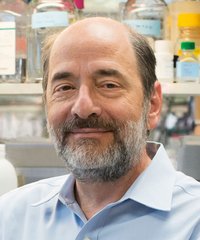
Portrait of a smiling man with short brown-and-gray hair and a salt-and-pepper beard, wearing a light blue collared shirt in a laboratory or pharmacy setting.

Michael Greenberg, Ph.D.

Nathan Marsh Pusey Professor of Neurobiology, Harvard Medical School
Professor of Neurology, Boston Children's Hospital
Director of the Hock E. Tan and K. Lisa Yang Center for Autism Research, Harvard Medical School

Michael Greenberg, Ph.D. – Faculty Profile

If you prefer, you can view the visual layout directly on Canva: Open Michael Greenberg – Faculty Profile on Canva (opens in a new window) .

Title: Nathan Marsh Pusey Professor of Neurobiology, Harvard Medical School; Director of the Hock E. Tan and K. Lisa Yang Center for Autism Research, Harvard Medical School; Professor of Neurology, Boston Children's Hospital.

The Aim

The Greenberg Lab studies how life experiences turn genes on or off to shape learning and brain development. The lab focuses on the molecular mechanisms by which sensory experiences regulate gene expression in the brain.

The Impact

This research has illuminated how the brain rewires itself in response to experience, a process essential for learning, memory, and behavior. Several of the genes and pathways the lab has identified are mutated in autism and other neurodevelopmental disorders, positioning this work as foundational for developing new therapies for these conditions.

A Closer Look

Article: State of Stasis , Harvard Medical School / Harvard Gazette, June 2020. This piece describes how Mike Greenberg and colleagues identified a tiny cluster of hypothalamic neurons that can flip mice into and out of a hibernation‑like state, or torpor, revealing brain circuits that dial down body temperature and metabolism and opening avenues for understanding suspended animation and its medical uses.

Article: Research Reveals Link Between Stress Hormone, Brain Plasticity in Early Life , Harvard Medical School, May 2026. This article describes a Nature study led by Mike Greenberg showing that in mice, the stress hormone cortisol sets off a chain of changes in star‑shaped brain cells called astrocytes. These changes help close critical periods of learning early in life by turning on more than 100 genes that mature the matrix surrounding neurons, and an analysis of human brain data suggests the same pathway exists in people.

Contact

Email: michael_greenberg@hms.harvard.edu
Lab website: greenberg.hms.harvard.edu

Publications View
Neuronal activity triggers widespread changes in RNA stability.
Authors: Authors: Duffy EE, Patop IL, Kalaora S, Assad EG, Koren SA, Traunmüller L, Krüttner S, Pajarillo NS, Finander B, Barsdale Z, Macias MM, Feng MY, Paulo JA, Griffith EC, Kalish BT, Gygi SP, Churchman LS, Greenberg ME.
bioRxiv
View full abstract on Pubmed
Novel environment exposure drives temporally defined and region-specific chromatin accessibility and gene expression changes in the hippocampus.
Authors: Authors: Traunmüller L, Duffy EE, Liu H, Sanalidou S, Krüttner S, Assad EG, Sun S, Pajarillo NS, Niu N, Griffith EC, Greenberg ME.
Nat Commun
View full abstract on Pubmed
Structural basis for the midnolin-proteasome pathway and its role in suppressing myeloma.
Authors: Authors: Nardone C, Gao J, Seo HS, Mintseris J, Ort L, Yip MCJ, Negasi M, Besschetnova AK, Kamitaki N, Gygi SP, Dhe-Paganon S, Munshi NC, Fulciniti M, Greenberg ME, Shao S, Elledge SJ, Gu X.
Mol Cell
View full abstract on Pubmed
Experience influences the refinement of feature selectivity in the mouse primary visual thalamus.
Authors: Authors: Sonoda T, Stephany CÉ, Kelley K, Kang D, Wu R, Uzgare MR, Fagiolini M, Greenberg ME, Chen C.
Neuron
View full abstract on Pubmed
Admission Neutrophil-to-Lymphocyte Ratio Is Superior to WBC Count at Predicting the Presence and Severity of Pediatric Musculoskeletal Infection.
Authors: Authors: Hou BQ, Chandrashekar AS, Jamal NH, Hefley WF, Anand M, Hajdu KS, Chenard SW, Greenberg M, Nian H, Pennings JS, Seltzer RA, Cassat JE, Moore-Lotridge SN, Schoenecker JG.
J Bone Joint Surg Am
View full abstract on Pubmed
FOS binding sites are a hub for the evolution of activity-dependent gene regulatory programs in human neurons.
Authors: Authors: Carter AC, Koreman GT, Petrocelli JE, Robb JE, Bushinsky EM, Trowbridge SK, Kingsley DM, Walsh CA, Song JHT, Greenberg ME.
bioRxiv
View full abstract on Pubmed
Human-chimpanzee tetraploid system defines mechanisms of species-specific neural gene regulation.
Authors: Authors: Song JHT, Carter AC, Bushinsky EM, Beck SG, Petrocelli JE, Koreman GT, Babu J, Kingsley DM, Greenberg ME, Walsh CA.
bioRxiv
View full abstract on Pubmed
Novel environment exposure drives temporally defined and region-specific chromatin accessibility and gene expression changes in the hippocampus.
Authors: Authors: Traunmüller L, Duffy EE, Liu H, Sanalidou S, Assad EG, Sun S, Pajarillo NS, Niu N, Griffith EC, Greenberg ME.
bioRxiv
View full abstract on Pubmed
Structural basis for the midnolin-proteasome pathway and its role in suppressing myeloma.
Authors: Authors: Nardone C, Gao J, Seo HS, Mintseris J, Ort L, Yip MCJ, Negasi M, Besschetnova AK, Kamitaki N, Gygi SP, Dhe-Paganon S, Munshi N, Fulciniti M, Greenberg ME, Shao S, Elledge SJ, Gu X.
bioRxiv
View full abstract on Pubmed
Cell-specific delivery of GJB2 restores auditory function in mouse models of DFNB1 deafness and mediates appropriate expression in NHP cochlea.
Authors: Authors: Ivanchenko MV, Booth KTA, Karavitaki KD, Antonellis LM, Nagy MA, Peters CW, Price S, Li Y, Lytvyn A, Ward A, Griffith EC, Hrvatin S, Greenberg ME, Corey DP.
bioRxiv
View full abstract on Pubmed