
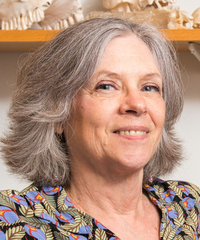
Marge Livingstone, Ph.D.
Open the Margaret Livingstone faculty profile graphic in Canva (opens in a new tab)
Margaret Livingstone, PhD
Takeda Professor of Neurobiology
Department of Neurobiology, Harvard Medical School
Email:
margaret_livingstone@hms.harvard.edu
Website:
Livingstone Lab website – more information about Margaret Livingstone’s research (opens in a new tab)
The Aim
The Livingstone Lab studies how we learn to recognize faces, objects, and scenes, with a focus on visual development.
The Impact
The Livingstone Lab studies how the brain develops the ability to recognize and differentiate between objects we see in everyday life, including faces, cars, and animals. Certain brain cells become specialized for these tasks based on our experiences. By understanding how these areas of the brain develop and function, this research can help explain why some people have difficulty recognizing forms and images, such as is the case with dyslexia and face blindness. This knowledge could lead to better support for people with vision or learning difficulties, and could improve diagnosis or treatment for related disorders.
A Closer Look
McGovern.MIT.edu – January 2024: Scolnick Prize awarded to Margaret Livingstone (article, opens in a new tab)
MIT’s McGovern Institute announces Livingstone as the winner of its most prestigious neuroscience prize, the Scolnick Prize. It honors her for her discovery that face‑recognition regions in the brain are not hard‑wired at birth, but must be built from experience, overturning a decades‑old assumption about how the cortex organizes itself.
Brandeis.edu – October 2024: Rosenstiel Award for discoveries in face recognition (article, opens in a new tab)
Livingstone is named co‑recipient of the prestigious Rosenstiel Award (alongside Nancy Kanwisher, Winrich Freiwald, and Doris Tsao) for discovering how and where in the brain face recognition happens. This discovery includes mapping a network of six interconnected face areas and probing the specific features that make individual neurons respond.
Phys Med Biol
View full abstract on Pubmed
Nat Neurosci
View full abstract on Pubmed
Nat Commun
View full abstract on Pubmed
Nature
View full abstract on Pubmed
Phys Med Biol
View full abstract on Pubmed