
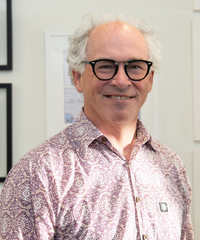
Accessible description of graphic: One-page profile titled “Gord Fishell, Ph.D.” with the subtitle “Professor of Neurobiology, Harvard Medical School.” At the top right is a portrait photo of Gord Fishell. Under the title there are two circular buttons: one linking to his email address and one to his laboratory website. The email button links to gordon_fishell@hms.harvard.edu and the lab button links to fishelllab.hms.harvard.edu .
Under the heading “The Aim”, the text reads: “The Fishell Lab investigates how inhibitory interneurons, the brain's primary gating system of information flow, are generated and integrated into circuits during development.”
Under the heading “The Impact”, the text explains that brain function depends on a balance between excitation and inhibition, and that inhibitory interneurons are responsible for maintaining that balance. The Fishell Lab’s research reveals a remarkable diversity of interneuron subtypes, each with its own shape, connectivity, and function. Mapping the developmental origins of interneuron diversity is opening new avenues for therapeutic approaches to conditions such as autism and schizophrenia.
A section titled “A Closer Look” highlights two featured studies. The first is labeled “Nature – May 2026” and is illustrated with a multipanel figure. The caption explains that this paper discusses new research that pinpoints a specific set of brain cells in mice that rapidly detect danger and convert signals from memory and emotion centers into defensive actions such as freezing or escaping. You can read this article at the related Nature publication (external link) .
The second featured item is labeled “Harvard Medical School – December 2021”, with an illustration titled “The Brain’s Wiring Technicians.” The text explains that Gord Fishell’s team discovered a specialized subset of microglia—immune cells in the brain—that home in on and selectively “prune” inhibitory synapses via GABA receptors. This pruning helps balance excitation and inhibition in developing circuits and suggests new ways to fix miswired brain networks in disorders such as autism, ADHD, and schizophrenia. A related article can be accessed at the Harvard Medical School feature on this research (external link) .
At the bottom, the graphic repeats his role and contact information: “Gord Fishell, Ph.D., Professor of Neurobiology, Harvard Medical School”, with the email gordon_fishell@hms.harvard.edu and the lab website fishelllab.hms.harvard.edu .
Proc Natl Acad Sci U S A
View full abstract on Pubmed
J Neurosci
View full abstract on Pubmed
Proc Natl Acad Sci U S A
View full abstract on Pubmed
Eur J Neurosci
View full abstract on Pubmed
FASEB J
View full abstract on Pubmed
Neuroscience
View full abstract on Pubmed